

Family Law Litigation Services in Colorado: Full Representation, Limited Scope, and Strategy Sessions
Explore your options for family law litigation services in Colorado, including full-service representation, limited scope representation, and hourly strategy sessions. Learn how to choose the right level of legal support for your case, goals, and budget.
Every case—and every client—is different. We offer flexible representation options so you can choose the level of legal support that fits your needs, goals, and budget The following applies for litigation services only. To learn more about our estate planning services, please view our estate plan pricing page.
Full-Service Representation - Comprehensive legal support from start to finish
This option is for clients who want an attorney handling every aspect of their case.
With full-service representation:
Your attorney formally enters an appearance in your case.
We draft and file all necessary pleadings and court documents.
We communicate directly with opposing counsel or parties on your behalf.
We prepare you for hearings and attend court with you.
We guide your case through each stage of litigation, from initial filing through resolution.
You and your attorney will remain in regular communication as the case progresses, ensuring that you understand the process and options and can make informed decisions.
Billing Structure: This option requires an upfront retainer. Legal fees are billed against that retainer as work is performed.
This is the best choice for clients who want a more attorney-led experience, ongoing legal guidance, courtroom representation, and a fully managed case.
Unbundled / Limited Representation- You lead your case—with professional guidance along the way
Limited representation is designed for clients who prefer to represent themselves but want access to an attorney for advice and strategy.
Under this arrangement:
You remain a self-represented party.
The attorney does not enter an appearance in your case.
We do not draft or file pleadings on your behalf.
You may consult with us as needed for:
Reviewing pleadings before filing,
Analyzing financial disclosures and legal issues,
Discussing case strategy,
Evaluating settlement offers, and
Reviewing agreements before signing.
This option allows you to stay in control of your case while benefiting from professional legal insight at critical decision points.
Billing Structure: A lower retainer is required. This option is generally more cost-conscious and allows you to use attorney time at your discretion.

This is ideal for clients who are organized, proactive, and comfortable managing their own case but want guidance to avoid costly mistakes.
Hourly Strategy Sessions - Focused, case-specific legal advice when you need it
If you are not ready to retain counsel but need experienced legal insight, strategy sessions may be the right fit. We offer a 45-minute initial consultation for a flat fee of $100.
During this initial session, an experienced attorney will:
Review your situation
Identify potential risks and options
Discuss likely procedural steps
Outline a practical strategy moving forward
After the initial consultation, you may schedule one-hour strategy sessions at the attorney’s hourly rate. These sessions are designed to be productive and focused. We can:
Review documents, pleadings, or settlement proposals
Help you prepare for court
Answer specific legal questions
Discuss negotiation strategy
Clarify procedural requirements
Billing Structure: You may schedule as many sessions as you find helpful. We simply ask that each session be paid in advance.
This option works well for clients who want professional guidance about specific issues or at specific times without committing to ongoing representation and higher costs.
Please feel free to email admin@gantlawoffice.com or call (970) 368-3684 for more information about our different services.

Settlement vs. Hearing in Colorado Family Law Cases: Costs, Timing, and Control
Learn the key differences between settling and going to a hearing in Colorado family law cases. Explore costs, timing, control, and co-parenting considerations to make informed decisions during divorce or custody proceedings.
When proceeding with a divorce, legal separation, or allocation of parental responsibilities case, every couple will face a major question at some point in the process: Should we settle or go to a hearing to let the judge decision? Either option could be the right one.

At Gant Law, we believe that reaching a compromise is holistically almost always better than letting a court choose your compromise instead. These cases involve splitting up assets and debts, determining who will be responsible for various expenses, setting a parenting time schedule and decision-making authority for any minor children, establishing child and spousal support obligations, and the like—these are very personal subjects, and every couple knows their own lives better than a court ever can. You may have heard legal professionals say that just about no one is ever 100% satisfied with the resolution of every issue in family cases, and this is true due to the nature of the issues and overall presumptive legal goal of fairness to both parties. However, it’s nearly always better, overall, to reach agreements where each party has a say in which gains and losses they walk away with, personalized to them, rather than leaving the result in the court’s hands. Below are a few major benefits that come with reaching settlement agreements.
Timing: Parties to a case can often move far more quickly than a court can. Depending on the county, the docket, and the parties’ personal schedules, a full day hearing in court often gets set out three to six months—this time is extended even more if additional time in court is needed. So long as the parties and their legal representatives (if they have hired counsel) openly and regularly communicate throughout the process, swap financial information in a timely manner, propose ideas for agreements, and attend mediation as soon as it makes sense, then cases can move more swiftly. There is a 91-day period between the time a divorce petition is filed and when the court is legally able to enter a divorce decree. Besides that, the timing of attempting to settle is in the hands of the parties.
Costs: Reaching a settlement agreement is nearly always less expensive than attending a hearing, the legal fees for which can easily exceed ten to thirty thousand dollars. Two parties reaching a complete agreement as to every single issue in the case is the cheapest possible outcome. Of course, it’s also never a bad idea to seek legal counsel to some extent, whether to simply get an expert opinion on a proposed agreement or for full representation in a more contentious case. In many instances, parties may be able to agree about a few things initially but not about every single issue right away. Absent specific circumstances, the court will always require that the parties mediate before setting a hearing anyway. If mediation goes well but the parties run out of time to finalize everything, they always have an opportunity to mediate again and again until all possible agreements have been reached. Any issues that remain in dispute must be determined by the court in a hearing. When represented by counsel, the costs of going through a hearing are usually very high, which is an important consideration before a hearing. For example, say a divorcing couple is disputing who should keep a marital asset valued at $2,000. If the agreement hinges on this, and the alternative is the parties have to attend a full-day hearing on the division of marital property, it could be a sensible compromise to agree to let the other party keep the asset and seek a different compromise rather than spending tens of thousands of dollars in legal fees for court.
Control: Again, almost no party to a family law case ever finds themselves 100% satisfied with the outcome. This is, in large part, because these cases simply require a lot of change, and the changes can feel painful at first, both personally and financially. Parties may have to move to a new home, start splitting time and holidays with their children, divide their hard-earned assets, and take on previously split expenses on their own. Settlement provides the opportunity for parties to negotiate small wins and losses and be a bit better off than what they otherwise risk by allowing a court with limited time and context to decide for them. Judges themselves even strongly encourage parties to attempt to reach agreements. There is not enough time in a typical hearing to present every single relevant detail to a judge, so they have to do their best with what they’re presented. This can make both parties feel unheard and unhappy to an uncertain extent. In contrast, settlement allows the parties to voice their opinions, maintain a bit more control, think more creatively, and agree to customized plans that likely meet somewhere in the middle of both sides’ preferences.
Co-Parenting: For family cases involving minor children where both parties are fit parents (and there are no exigent/emergency circumstances involved), how a couple approaches a case can also set the tone for their child(ren)’s experience with the process and for future co-parenting. Children tend to be naturally impacted by their parents parting ways—they are also often observant and intuitive, making them privier to the emotions and actions of the adults around them than they’re given credit for. While it can certainly be easier said than done, when parties try to approach their case collaboratively, this can aid in decreasing the tension and fear experienced by their children. Regardless of what led to the end of the relationship, couples who are able to place their children’s best interests at the forefront and remain civil, reasonable, and collaborative can protect their children while also making the process easier and perhaps even friendlier for themselves, which is the hope for co-parenting after the case has ended.
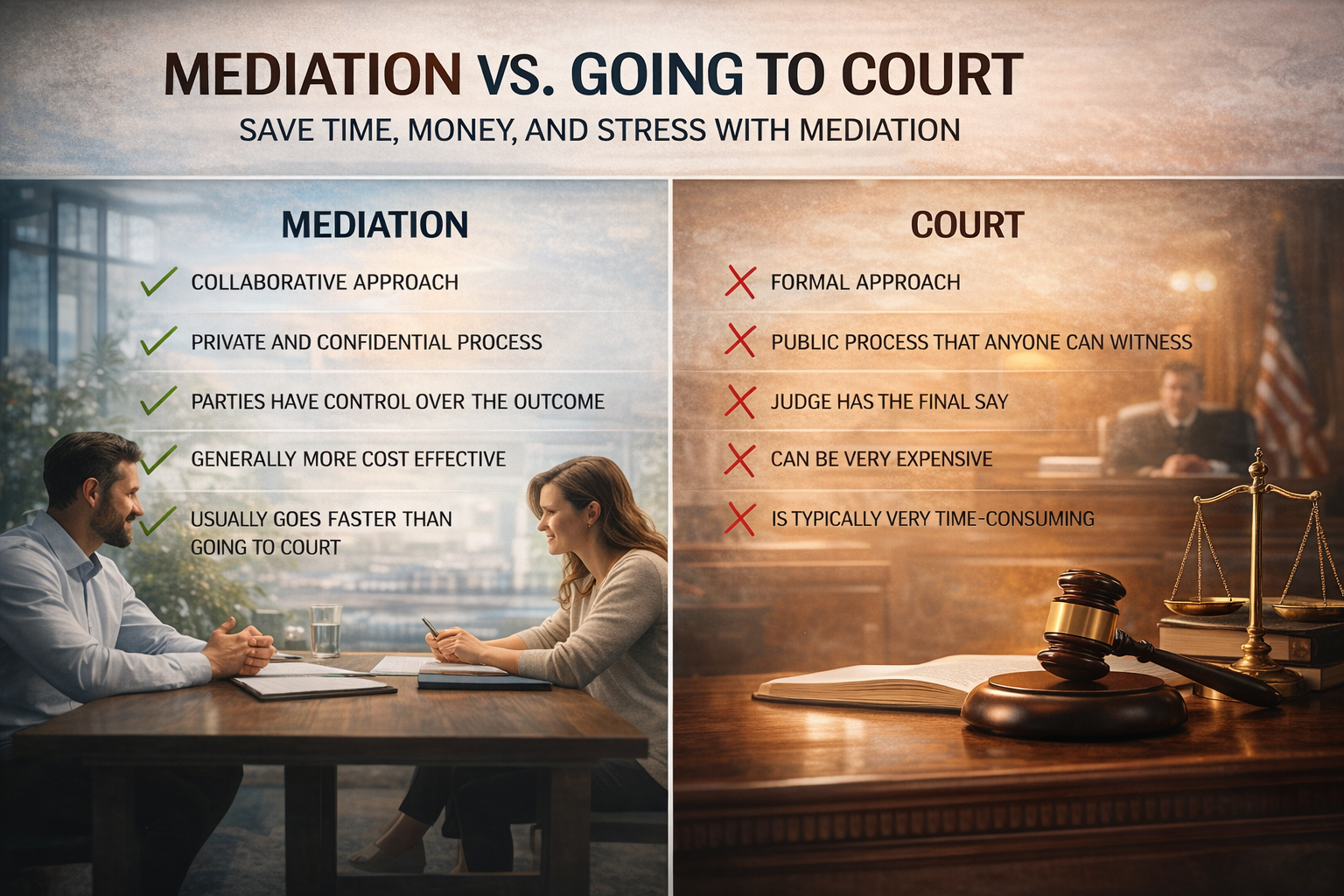
While we strongly believe in avoiding needless litigation whenever possible, we also understand that going to court can be appropriate—and even necessary—in certain cases, and we take our role of advocating for clients in court very seriously. When one party unreasonably refuses to budge on a vital issue, even after settlement attempts, it may be best to bring that issue in court. For example, if one party will only agree to having 100% of the parenting time with their children and the other party is a loving, responsible parent, then that party should indeed present their case to a judge. This is when it’s important to have experienced, mindful counsel who will make every effort to ensure their client has realistic expectations and will encourage compromise, rather than going through a long, expensive hearing only to achieve the anticipated result anyway.
Regardless of your situation, our experienced and compassionate family law attorneys can help you navigate the options, benefits, and risks involved with settling or going to court.

Why ChatGPT Is Not Helping Your Legal Case
If you are involved in a legal case, chances are you are stressed, overwhelmed, and looking for ways to feel more informed and prepared. That instinct makes sense. Many clients are now turning to tools like ChatGPT to summarize their case, organize their thoughts, or research legal issues. On the surface, this can feel proactive and helpful. In practice, it often does the opposite. This post is not about criticizing curiosity or discouraging engagement. We want informed clients. We welcome questions. But it is important to understand the real limits of current AI tools, especially in legal matters, and how using them the wrong way can actually slow your case down and increase your legal fees.
Why AI Summaries Create Problems in Legal Cases
Large language models like ChatGPT are not legal experts. They do not understand your case, the full factual record, or the procedural posture you are in. They do not know what evidence is admissible, what facts are legally relevant, or what details matter most at a given stage of litigation. Instead, they do something very different. They generate text that sounds confident and coherent, whether it is correct or not. That creates several problems.
First, accuracy is a serious issue. AI tools routinely misstate the law, invent legal standards, misapply statutes, or confuse similar concepts. This is not a rare edge case. It happens often, especially in state specific law, nuanced procedural issues, and fact intensive disputes. When a client sends us AI generated legal analysis, we cannot assume any of it is correct. Every sentence has to be independently verified.
Second, volume becomes the enemy. Many clients use AI to produce long narratives or summaries that run hundreds or even thousands of pages. Reviewing that material takes significant attorney time. More importantly, it is time spent filtering and correcting content rather than advancing your case. That time is billable, and it rarely produces value.
Third, AI often distorts what matters. These tools tend to flatten facts, overemphasize emotional language, and focus on issues that feel important rather than those that are legally decisive. That can unintentionally steer attention away from the strongest arguments and evidence in your case.

Finally, there is a trust problem. When content is clearly AI-generated, we have to question where it came from and how it was created. Was it based on complete facts? Were key details left out? Was it influenced by assumptions that are simply wrong? That uncertainty makes it harder, not easier, to rely on the information.
Why This Can Cost You More Money
Many clients assume that sending AI summaries will save time and reduce legal fees. In reality, it usually increases them. When we receive AI-generated material, we cannot skim it. We have to read it carefully, identify errors, separate fact from fiction, and then cross check it against the actual record. That process often takes longer than reviewing a concise, factual update written in your own words. In other words, you are paying for us to undo the work of a tool that was never designed to help your case in the first place.
What Actually Helps
If your goal is to be helpful and efficient, there are much better ways to do that. Start with facts, not analysis. If there are new developments, write them out plainly. Who did what, when, and where. Stick to what you personally observed or experienced. Be concise. Bullet points are often better than paragraphs. Short timelines are better than narratives. If something feels important to you, flag it, but do not try to argue the law around it. Ask questions instead of providing conclusions. If you are confused about an issue or something you read online, ask us directly. That gives us the chance to explain how the law actually applies to your situation. Let us do the legal analysis. That is what you are hiring us for. We know which facts matter, which arguments are viable, and which issues are red herrings. AI does not.
A Note on Using AI at All
This does not mean you can never use AI. Some clients find it helpful for organizing personal notes, drafting timelines for their own reference, or generating questions they want to ask their attorney (but don’t forget that any info you put in is essentially public!). Used as a thinking tool rather than an authority, it can be fine. The problem arises when AI output is treated as reliable legal analysis or submitted as part of the case itself. At this stage, AI is a powerful writing tool, not a trustworthy legal advisor.
The Bottom Line
We understand the urge to do something, anything, when you are in the middle of a legal dispute. But more information is not always better information. Clear, accurate, and relevant facts are what move cases forward. If you are ever unsure whether something is helpful to send, ask first. We would much rather guide you toward what will actually help than bill you for sorting through pages of material that will not help you. If you have questions about this, or want to talk about the most effective way to communicate about your case, we are always happy to do that.

Legal Separation vs Divorce in Colorado: Key Differences, Similarities, and How to Decide
When a married couple or couple in a civil union chooses to end their relationship, a question that may come up is whether to pursue a legal separation or a divorce. While they are very similar, there are some key legal differences, so it’s important to understand both before proceeding.

SIMILARITIES
A legal separation and a divorce are nearly identical procedurally and result in orders covering the same legal issues, including those related to children (parenting time, decision-making, child support, etc.) and financials (property division, maintenance/spousal support, etc.). As traditional marriages and common law marriages are treated the same, a couple in either type of marriage can pursue a legal separation or a divorce. For a Colorado court to have jurisdiction over either case, one party must have lived in Colorado for at least 90 days, and if the couple has any joint minor children, the children must have lived in Colorado for at least six months (or since birth, if younger than six months old). Both cases have the same steps in court, including filing an initial petition, serving the other party if the petition is not co-signed, exchanging financial information, and attending a final hearing if agreements cannot be reached. Neither type of case is de facto quicker, easier, or more amicable than the other. Both vary in time and costs which depend on many factors, a main one being whether the couple is able to reach agreements or not.
DIFFERENCES
A divorce is the legal process to terminate a marriage, while a legal separation is the process to live separately from a spouse without the termination of the marriage. After a divorce, the parties part ways with separate finances and a custody arrangement for any children. They can also remarry at any time after receiving a divorce decree. For purposes of inheriting from an ex-spouse, unless there is a beneficiary designation or valid written agreement, divorced spouses lose rights to the estate of their deceased ex-spouse as well as any priority to act as their personal representative, agent, and the like.
After a legal separation, the parties also live completely separate lives; however, the parties remain legally married, so they cannot remarry unless they convert the legal separation into a divorce. In addition, absent a marital agreement to the contrary, couples who legally separate still keep their inheritance rights. This means that if one spouse passes away, the other has rights to the deceased spouse’s estate afforded to surviving spouses by law.
CHOOSING BETWEEN A LEGAL SEPARATION & DIVORCE
There are a few reasons why couples choose to legally separate rather than get divorced. A common reason is that divorces conflict with certain religious views and practices. A legal separation can allow the parties much of the same legal recourse of a divorce while upholding their religious values. Sometimes couples also choose a legal separation for financial reasons, such as to continue filing taxes together, to keep a certain health insurance policy, or to preserve inheritance rights. Finally, a legal separation can be beneficial for couples who would like to take some time to assess their relationship—and perhaps even contemplate reconciliation—before experiencing the finality of a divorce.
ONE SPOUSE WANTS A LEGAL SEPARATION BUT THE OTHER SPOUSE WANTS A DIVORCE
One spouse can always proceed with a divorce for any reason—it’s unlawful to force someone to stay legally married. On the other hand, one spouse cannot force the other to proceed with a legal separation if the other wants a divorce. In that scenario, if a spouse files for a legal separation, the other has two options. They can either file a motion to modify the petition for legal separation to a divorce (see JDF form 1107*), or they can wait to receive the legal separation decree, then file a motion to convert the decree of legal separation to a decree of divorce (see JDF form 1321*). However, conversion can only occur six months after receiving the decree of legal separation.
WHAT’S RIGHT FOR YOU?
If you’re unsure which track to choose, given the legal implications, it’s highly recommended that you seek professional counsel who can assess your particular situation—and competently and tenaciously represent you in either type of case. We understand that the end of a relationship can feel overwhelmingly difficult. If you’re in this situation and you’re seeking guidance and/or representation, please contact us today to schedule a consultation with one of our experienced family law attorneys.
*Please Note: While it’s often ideal to retain the services of an attorney, it’s also important to know that representation is not required, and anyone can proceed with domestic relations cases without legal counsel. The courts supply many helpful resources and JDF forms for public use. All necessary forms can be downloaded from the Colorado Judicial Branch website under Self-Help and Forms. The court’s general guide for how to file for a divorce or legal separation and list of other required forms can be found on JDF 1010.

Understanding Adult Guardianships and Conservatorships in Colorado: A Guide for Families
Do you have an adult loved one who has a neurogenerative disease, experienced a sudden brain injury, or has shown a noticeable decline in their ability to take care of themselves or their finances? Do you have a child with a cognitive disability who will be turning 18 in the near future? Do you have worries that someone, even another family member, may be taking advantage of an elderly loved one without their knowledge? If the answer to any of the above is yes, a protective case (called a guardianship or a conservatorship or both) may be an avenue to consider sooner rather than later.

Media coverage of Hollywood adult guardianships and conservatorships (Britney Spears, Amanda Bynes, and Brian Wilson to name a few) has resulted in widespread educational discourse about how protective cases work—unfortunately, it has also led to the mass spread of disinformation. The goal of this article is to serve as an accurate, in-depth guide for protective cases in Colorado.
TWO TYPES OF PROTECTIVE CASES: WHAT IS A GUARDIANSHIP VS. A CONSERVATORSHIP?
The purpose of both types of protective cases is to ensure someone qualified is able to make decisions on behalf of a protected person. A protected person is someone who the court determines cannot make decisions for themselves, and this may be because they are an incapacitated adult, which will be the main focus of this article, or because they are a minor. A guardian is in charge of decisions related to the protected person’s medical/health care, residence, and overall wellbeing. A conservator is in charge of decisions related to the protected person’s real and personal property, income, and any other financial or business interests. Each type has slightly different legal standards, but it’s common for both to occur in the same case.
WHAT ARE THE LEGAL STANDARDS?
To appoint a guardian in Colorado, the court must find by clear and convincing evidence that:
(1) The respondent is incapacitated, meaning:
a) They are unable to effectively receive and evaluate information or make or communicate decisions, even with the use of appropriate and reasonably available technological assistance; and
b) This incapacity impairs their ability to meet essential requirements for physical health, safety, or self-care;
(2) The appointment is necessary to provide continuing care and supervision of the respondent; and
(3) No less restrictive alternative is available and appropriate.
To appoint a conservator in Colorado,
(1) the court must find by clear and convincing evidence that the individual is unable to manage property or business affairs because of:
a) Incapacity, meaning they are unable to receive and evaluate information or make or communicate decisions, even with appropriate and reasonably available technological assistance,
b) Detention/incarceration,
c) Disappearance, or
d) Inability to return to the US; and
(2) the court must find by a preponderance of the evidence, either:
a) the individual has property that will be wasted or dissipated unless management is provided, or
b) money is needed for the support, care, education, health, or welfare of the individual or someone the individual is obligated to support.
These cases require a fact-intensive analysis, and every case is different. However, some common patterns that show a person may need a guardianship include when a person cannot properly feed themselves, practice proper hygiene, take prescribed medications, attend or remember scheduled doctor’s appointments, remember regular, daily things or people, or take care of themselves in general. For a conservatorship, common fact patterns include when a person repeatedly fails to remember to pay bills, lets the electricity, water, or other utilities turn off in their home without following up, falls victim to scams or family members/friends taking advantage of them, or fails to take care of their property or funds in general.
WHAT IS THE GENERAL COURT PROCESS?
To be appointed as a guardian or conservator or both, you must be at least 21 years old and file a petition and other required paperwork* with the court in the county where the person to be protected (also called the “respondent”) resides. The court will then set a hearing date around 60 days out from the date of filing, which may be in person or virtual depending on the county. No later than 14 days before the hearing, all of the paperwork, including a notice of the hearing, must be personally served on the respondent. It’s best to coordinate service to occur when the respondent is in an environment where they feel safe with a process server who has experience and will make them feel comfortable, if possible. The paperwork must also be served by mail to any interested persons so they will have the opportunity to object to the petition, if they choose. Interested persons may include the respondent’s spouse, adult children, parents, caretakers, legal representatives, creditors, and anyone else who may have an interest in the proceeding. The court will appoint a Court Visitor who will interview the respondent, the petitioner, other people in the respondent’s close circle, and care providers (if the respondent lives in a care facility) to create a report to aid in deciding whether the ward needs a guardianship and/or a conservatorship. The respondent must attend the hearing unless the court determines there is good cause for their absence. If the case is uncontested, the petitioner will simply make their case to the court during the hearing. Depending on whether there are objections, the court may appoint an attorney or a guardian-ad-litem to represent the respondent’s interests.
WHO HAS PRIORITY FOR APPOINTMENT?
A person above the age of 21 with concerns about the respondent’s wellbeing and/or finances may be appointed as guardian, conservator, or both. While it’s often helpful to live nearby, there is no requirement that such person live in Colorado.
The order of priority for a guardian is: (1) a person nominated by the respondent in a valid durable power of attorney or other writing; (2) an agent under medical power of attorney; (3) the spouse or partner in a civil union of the respondent; (4) an adult child of the respondent; (5) a parent of the respondent; (6) an adult with whom the respondent has lived for more than six months before the petition is filed; and (7) any other person the court deems appropriate, including a private/professional guardian.
The order of priority for a conservator is: (1) a person nominated by the respondent in a valid power of attorney or other writing; (2) an agent under financial power of attorney; (3) the spouse or partner in a civil union of the respondent; (4) an adult child of the respondent; (5) a parent of the respondent; and (6) any other person the court deems appropriate, including a private/professional conservator, public fiduciary, or trust company.
If a case is already open and an interested person has concerns about a guardian’s and/or conservator’s performance on behalf of a loved one, and the evidence is substantial enough, an interested person may have the option to petition to remove them and appoint someone else instead (including themselves if they are qualified).
CAN MORE THAN ONE PERSON BE APPOINTED?
In some situations, such as two parents looking after an incapacitated adult child, it’s a good idea to have two co-guardians and/or co-conservators. In those situations, the court documents should be drafted to ensure that both parties are able to act on their own without the need for both to sign off on every decision. Then, if the child needs to go to a medical appointment but one parent can’t go, the other can go alone and make sure the child gets medical attention without issue. In other situations, such as two adult children who don’t get along but want to be part of looking after their parent, it may not be a great idea to have both serve as co-guardians or co-conservators, depending on the dynamics and facts involved. The court’s main concern is what is best for the respondent, and two petitioners who don’t work well together isn’t necessarily the best outcome. This runs the risk of them hitting a standstill if they disagree about a particular decision and have to get a court order in order to take action—spending time litigating without being able to act can put the protected person’s wellness or finances at risk. Instead, if there are competing petitions, the court may determine something else is best, such as: one to serve as both roles; one to serve as guardian and one to serve as conservator; or, if they’re co-guardians/co-conservators, then one to have the final say in case of disagreements. Again, the court documents must be drafted clearly and accurately so that various entities can easily understand the scope of authority.
WHAT DOES THE COURT REQUIRE AFTER APPOINTMENT?
Once appointed as guardian and/or conservator, the court will set deadlines to complete and file an initial guardian’s report and/or an initial conservator’s financial plan with inventory. A report for both types of cases will be due every year after that, typically on the respondent’s birthday.
WHAT ARE THE DUTIES OF A GUARDIAN AND A CONSERVATOR?
Beyond the reports for the court, guardians and conservators have many ongoing legal duties (and some limitations), and it’s important to be familiar and compliant with them. For guardians, the duties include, but are not limited to, arranging for the protected person’s medical needs, housing, food, clothing, hygiene, personal care items, housekeeping, transportation, spiritual needs, recreation, and any hired professionals for the same. However, there are some things a guardian does not have authority to consent to against the protected person’s will. Special procedures are required to obtain hospital or institutional care for mental illness, treatment from an agency for developmental disabilities, or treatment for substance abuse. A guardian also cannot move the respondent out of Colorado without a court order.
For conservators, the duties include, but are not limited to, locating and protecting all of the respondent’s assets, separating all assets from their own, managing and investing the respondent’s assets appropriately and without major risk, paying bills, ensuring there is insurance coverage where appropriate, ensuring taxes are current, maintaining a clean and complete written record of all transactions, and seeking professional advice and services when needed. It’s very important to only ever sign off on financial documents in the conservatorship capacity, rather than personally.
It’s also up to the guardian/conservator to stay current and competent about their legal duties and limitations. At the same time, a guardian/conservator should always attempt to include the respondent’s input in decisions, if possible.
SHOULD I/HOW DO I TALK TO MY LOVED ONE WHO MAY NEED PROTECTION ABOUT ALL OF THIS?
We often advise the petitioner to have a conversation with the respondent about the case and give them a warning, particularly before they are served with court paperwork, if possible and safe under the circumstances. Talking about this can be hard on both parties, especially depending on the respondent and their level of cognition and understanding. Sometimes respondents have a condition, such as very late-stage dementia, and can’t really understand what is happening (or don’t really care). Others understand that they need help and even want their family to step into these roles for them. In other situations, this process can be very tough on the respondent as they may feel confused, betrayed, scared, and a loss of autonomy. It can in turn be difficult for the petitioner as no one wants to make their loved one feel this way.
Regardless, it’s very important to recognize and empathize with the respondent’s feelings while remembering the end goal of ensuring their personal and financial safety. It’s best to be kind, patient, and honest, explaining the concerns to them and why the process feels necessary—the purpose is not to control, scare, or hurt them, but rather to help, protect, and express love to them. At the same time, it’s also important not to pressure or unduly influence them into accepting the appointment of a guardian and/or conservator. If they wish to object to it, they have the legal right to do so. The court will ensure they have representation (or the opportunity to have representation) if needed and will make the ultimate decision.
WHAT IF MY LOVED ONE’S CAPACITY IS WORSENING BUT NOT QUITE AT A POINT TO MEET THE LEGAL STANDARDS?
If the respondent’s level of capacity is in a gray area, the court may appoint a guardian and/or conservator in a limited capacity, personalized to the particular issues. This is often to ensure that the respondent still has responsibilities and feels in charge, but also that the petitioner can intervene and assist in particular situations of need. To provide some examples: a guardian may attend doctor appointments and assist with medical decisions but cannot make decisions about the respondent’s residence; a conservator may monitor and limit the respondent’s spending but cannot pay bills on the respondent’s behalf; the guardian/conservator must run every single decision by the respondent but may have the final say if there’s a genuine disagreement. If things worsen over time, a new petition can be filed for additional authority.
For anyone in general, but particularly for folks with a family history of cognitive disorders, it’s wise to consider speaking to an estate planning attorney about medical and general durable powers of attorney to nominate an agent(s) to be able to assist with health and financial decisions, respectively. A main goal of these documents, beyond ensuring an agent can step in to help if you become incapacitated, is to avoid the need for a guardianship or conservatorship altogether. If drafted properly, they function very similarly, meaning the agent can take a copy to assist with doctor’s appointments, banking, paying bills, etc. without the need for court involvement or annual reporting. The person signing a power of attorney and nominating an agent(s) must have capacity, so it’s important to try to complete these earlier rather than later, especially if there is fear of future decline in cognition.
I HAVE A MINOR CHILD WITH A DISABILITY AND EXPECT THEY WILL BE INCAPACITATED THROUGH ADULTHOOD – WHAT STEPS DO I TAKE?
Once a person turns 18, they are considered a legal adult by most entities in American society, including financial institutions, medical providers, and government agencies like the Social Security Administration. At that point, in order to assist them with things like medical treatment or government benefits, such entities will more than likely require a guardianship and/or conservatorship to have authority to make decisions on their behalf. Depending on the situation, the parent or legal custodian of the respondent can petition about two months before the respondent’s 18th birthday and request a court date for the birthday or shortly after that. Alternatively, if the 18th birthday is coming up quickly and there is a serious need for a guardianship and/or conservatorship, there is also an expedited version of the process. The legal standards for this are heightened, but if the situation is an emergency, the court may appoint an emergency guardian and/or special conservator to serve until the permanent one is ordered on the regular timeline.
It's also a good idea for parents to meet with an estate planning attorney and ensure they have official, written guardian and conservator nominations for any minor children as well as express, broad authority for their nominated fiduciaries to be able to make lawful gifts to minors or incapacitated beneficiaries in a way that’s in their best interests.
CONCLUSION
Adult protective cases can feel emotionally taxing and overwhelming for everyone involved. At Gant Law, we understand that every case has its own unique needs and we pride ourselves in doing everything we can to ensure these cases are resolved and tailored to the best interests of the protected person. If you’re worried about a loved one’s wellbeing, you feel like someone is pressuring or taking advantage of you or your loved one, or you’re interested in taking estate planning measures, please schedule a consultation with us and one of our attorneys will be happy to provide you with personalized advice.
*Please Note: While it’s often ideal to retain the services of an attorney, it’s also important to know that representation is not required, and anyone can proceed with protective cases without legal counsel. The courts supply many helpful resources and JDF forms for public use. All necessary forms can be downloaded from the Colorado Judicial Branch website under Self-Help and Forms. The court’s instructions and list of forms for appointment of a guardian and conservator for an adult can be found on JDF 840 and JDF 875, respectively.

How Much Does a Lawyer Cost in Colorado? A Transparent Look at Attorney Pricing
Gant Law explains how attorney pricing works in Colorado. Learn what hourly billing really means, what retainers cover, and how to keep legal costs down.
How Law Firm Pricing Really Works
In the 2025 legislative session, the General Assembly passed (and the Governor signed) HB 25-1090 Protections Against Deceptive Pricing Practices, which is set to take effect January 1, 2026. The goal of this legislation is to dispense with deceptive pricing practices in Colorado. At Gant Law, we fully support pricing transparency and wanted to take this opportunity to provide some insight into attorney pricing for those seeking legal services.
When hiring an attorney, one of the first and most common questions is: How does pricing work? For clients unfamiliar with legal services, the answer can feel opaque or even intimidating. At Gant Law, we believe transparency and clarity are essential. So, here’s a straightforward explanation of how hourly billing works—and what it actually means when you receive an invoice from a law firm.
What You're Really Paying For

Unlike purchasing a product with a price tag, legal services are not about materials or parts. What you’re paying for is a professional’s time, expertise, and judgment. An attorney’s service is their knowledge and experience—the ability to interpret the law, assess your case, and apply strategy to your unique situation.
The most common way to value that knowledge is by tracking the time spent delivering it. That’s why most Northern Colorado law firms, especially in complex areas like family law and probate, use hourly-rate pricing.
Why Not a Flat Fee?
You may have heard of attorneys offering flat fees, and in some practice areas—like simple estate plans or uncontested matters—that works well. But for areas like litigation, guardianships, contested divorce, or estate administration, there are simply too many variables. Every case is different. Every opposing party behaves differently. Every court has its own nuances and timelines.
In these types of cases, guessing at a flat fee could either overcharge the client or leave the attorney unable to cover the time truly required. Hourly billing allows for flexibility and fairness based on the actual complexity and duration of your case.
The Role of a Retainer
Clients are often confused about the term "retainer.” It’s important to understand that a retainer is not the total price of your case. Instead, it’s a form of prepayment—think of it like a down payment or security deposit.
These funds are deposited into a special trust account and remain your property until the attorney earns them by working on your matter. Some firms use the funds right away to pay your first few invoice (or invoices). Others hold onto the retainer for the life of your case and return it at the end if unused. Either way, anything not earned goes back to you.
In Colorado, trust accounts are regulated and monitored. Interest earned from these accounts (if any) is sent to the Colorado Lawyer Trust Account Foundation, which supports civil legal aid services for those who cannot afford it.
How Time Is Tracked (And Why It Matters)
Attorneys typically bill in time increments. In Colorado, courts have said that billing in up to 12-minute increments (or tenths of an hour) is legally permissible. But here’s the problem: if a task takes just one or two minutes, you could still be billed for the full 12.
At Gant Law, we don’t think that’s fair. We bill in 3-minute increments (or twelfths of an hour), which more closely aligns with the actual time tasks require. That means our clients are paying for what’s truly necessary—no more, no less.
Hourly Rates: What Do They Reflect?
Hourly rates in Northern Colorado for family law and probate matters often range from $225 to $450, depending on the attorney’s experience, knowledge, skill, and the complexity of the case. But here’s an important truth: a higher hourly rate doesn’t always mean a higher overall cost.
Why? Because experience brings efficiency. A seasoned attorney may complete a complex task in half the time it takes someone with less experience. That’s why the total cost of a matter is often more about efficiency and decision-making than just raw hourly numbers.
At Gant Law, we strive to assign the right task to the right professional. If a paralegal can do the job just as well, they will—and you’ll be charged the paralegal rate. If an attorney does a paralegal task for convenience, we’ll still bill you at the paralegal rate. If we do work that doesn’t meet our internal quality or timing standards, we may even reduce the rate or charge nothing at all. When two attorneys collaborate, and the full benefit of both isn't necessary, you'll also see that time billed at half rate.
What You're Billed For—and Why
If a task was required for your case, it is generally billable. That includes:
Reviewing records;
Drafting pleadings;
Analyzing facts and law;
Strategizing or preparing for hearings;
Communicating with you, the opposing party/attorney, witnesses, the court, etc.
It may surprise some clients to see time billed for reading emails or making quick phone calls. But that’s because even those actions require legal attention. Our job is to think critically about everything that enters your case—and that includes correspondence. Knowing the full facts on your case is the only way analysis can be comprehensive.
“We believe legal fees should never feel like a surprise.”
How to Keep Legal Costs Down
This is a question we’re always happy to answer. The number one tip: respond to your attorney’s requests accurately and on time.
It may sound simple, but it’s key. Nothing wastes more client money than delays caused by incomplete information. If your attorney asks for records, inventories, forms, or documentation, turn them in quickly, fully, and in the format requested.
Also, consolidate your questions when you can. Every email or call you send requires a response—and each response is time. We’re ethically required to respond, and we want to be helpful. But if you send 10 separate messages instead of one well-thought-out email, your bill will reflect that.
Transparency and Communication
Attorneys in Colorado are required to provide detailed billing records. At Gant Law, we send regular invoices (usually monthly) that show exactly how your matter is progressing. Every three-minute increment is accounted for. We aim to include enough detail so you know what was done, without exposing sensitive information in case the court ever needs to review the invoices.
We believe legal fees should never feel like a surprise. That’s why we’re transparent about both our pricing and your case’s direction. We’ll advise you about what’s coming up, the options you have, and what we can do to help manage expenses without compromising quality.
Final Thoughts
We know legal representation can feel expensive. Good legal work can also prevent costly mistakes, resolve conflict more efficiently, and bring peace of mind in difficult times. At Gant Law, we take seriously the responsibility of providing service that is both excellent and fair.
If you still have questions about how hourly billing works, or how we approach fees in your specific type of case, we’d be happy to talk with you. We don’t want you walking into a legal matter feeling unsure or confused—we want you feeling confident, informed, and empowered.

What is a Common Law Marriage in Colorado?
Colorado is one of the few states that recognizes valid common law marriages. For couples who haven’t sought a ceremonial marriage, it is critical to plan ahead by understanding the complexities and implications of a common law marriage—or a lack of the same.
Common Law Marriage & Legal Framework
A common law marriage is an alternative to a ceremonial marriage, which is the more widely known version with a ceremony and license. Legally speaking, there is no difference between the two, and a couple in a common law marriage has the same rights and duties as any other married couple, so it is very important for couples to start by considering whether or not they are in a common law marriage.
Statutory: Pursuant to C.R.S. § 14-2-109.5, a couple may enter into a common law marriage so long as each party is at least 18 years old and the marriage is not prohibited by C.R.S. § 14-2-110 (which prohibits bigamy and incest). That is all the statutory authority provided—whether a valid common law marriage actually exists must be analyzed under the relevant case law.
Factual Analysis: A common misconception is that a common law marriage exists based on the amount of time a couple has lived together. While co-habitation is one factor the court considers when determining whether a common law marriage is valid or not, the actual inquiry is whether there was a mutual agreement between the parties to enter into a marital relationship, followed by a mutual and open assumption of the marital relationship. From a court perspective, intending to enter into a marriage is completely different from a financial, platonic, or even romantic relationship. The person claiming the existence of a common law marriage has to establish it by clear and convincing evidence, and it is a fact-intensive, high legal burden. The most recent leading case on this issue (In re Marriage of Hogsett, 478 P.3d 713 (Colo. 2021)) lays out a non-exhaustive list of factors the court considers:
1. Reputation in the community as spouses

2. Joint tax returns
3. Joint ownership of real estate
4. Joint financial accounts (bank accounts, investment accounts, etc.)
5. Shared financial obligations (mortgages, leases, bills, etc.)
6. Shared surname for children
7. Health insurance
8. Beneficiary designations
9. Mention of other person in estate planning documents (e.g., named as husband, wife, or spouse vs. girlfriend, boyfriend, partner, friend, etc.)
10. What they call each other publicly, in front of family, friends, and peers, on social media, etc.
11. Ceremonies
12. Wedding rings
13. Cohabitation
Official Documents Required: Despite the long, non-exhaustive list of factors the court may consider, it is important to note that courts currently give far more weight to a couple’s official documents than other factors. Such documents include, first and foremost, how the couple files taxes, whether they are listed as spouses for health insurance purposes, and whether/how they list each other in estate planning documents such as wills, trusts, powers of attorney, and the like. Without evidence of these, even if all other factors are in favor of the existence of a common law marriage, the court is highly likely to find there is no marriage.
For same-sex couples, the inquiry may be different depending on the timing of events. Same-sex marriages were prohibited until the United States Supreme Court decision in Obergefell found this ban unconstitutional and allowed same-sex couples to marry in 2015. Because of the ban, same-sex couples could not list each other on official documents prior to that time, but the other factors and conduct prior to 2015 will still be considered when determining whether a common law marriage exists and when the marriage began.
Legal Implications
For couples who either intend or do not intend to be in a common marriage, there are important legal implications to consider ahead of time.
Legal Separations and Divorces: If a couple has entered into a common law marriage and wants to end their relationship, they must go through the formal legal separation or divorce process to equitably divide marital property and determine support obligations, if any. It is easy to imagine why this may lead to contentious litigation. If the court finds there was no marriage, there is no required division of marital property and no maintenance order, which is especially important if the couple decided in the past that one partner would work to earn an income and the other would stay home to maintain the household. Issues also arise when couples dispute the length of the common law marriage, which is relevant for maintenance (alimony) purposes as well as designating property as marital or separate. Importantly, if a couple splits up without getting a divorce and one of them remarries, the second marriage may be found valid/void as bigamy if it can be shown that the first relationship was a common law marriage.
Probate and Estates: If a couple is married and one of them passes away, the other has certain rights with regard to the estate, and this applies to common law spouses the same as other spouses. For example, if a person passes away without a will, the partner may have priority for appointment as personal representative and may have certain rights to the estate as a surviving spouse. If the person who passed did not make it clear whether they intended to enter a marriage and/or whether they intended to leave their all or a portion of their estate to their partner, this can lead to disputes between the surviving partner and other family members during the probate process. It’s very important to create an estate plan with intentions clearly laid out.
Planning Ahead
If you have questions related to common law marriage such as getting divorced, probate rights, estate planning, or whether you’re even in one, it’s highly recommended that you consult with legal counsel. At Gant Law, our attorneys have experience with each of these areas of law. Give us a call or contact us via email to schedule a consultation and we’ll be happy to discuss your particular situation and next steps needed to reach your goals.

What are Legal Retainers: A Guide by Gant Law, Your Greeley, Colorado Family, Probate, and Estate Planning Experts
If you're in Greeley, Colorado, and seeking advice on a family, probate, or estate-planning matter, Gant Law is your local go-to law firm. We understand that legal terms can be overwhelming, so let's unravel the mystery behind one such term – legal retainers.
What's a Legal Retainer, Anyway?

Alright, let's get to the bottom of this retainer business. Think of it like this: when you're about to hire a lawyer to tackle your legal woes, what are they giving you in return? Their time. But once they’ve put in their time, it’s expended, and they cannot withhold it to ensure payment. Thus, the legal retainer. You can think of it as an upfront payment by a client for future time the attorney will put in. It’s the assurance of payment before they roll up their sleeves and dive into your case.
Now, these retainer funds can also go by the name "trust funds." Fancy, right? But don't let that throw you off. This is just a way to assure both you and the lawyer that you're committed to this legal journey.
It's Still Your Money (Mostly)
The important thing about a retainer is that the money you put in is still yours until your lawyer earns it. Your lawyer needs to put in some hours and effort to earn retainer funds. So, until they've put in the work, it's your money, just kept in a safe account. And another cool part? The law firm does not earn any interest on that account. Instead, it goes to a public fund to help with legal needs for those who cannot afford a lawyer.
What Happens After the Legal Dust Settles?
Your legal matter is all sorted, and your lawyer has fought the good fight. What happens if you have leftover retainer funds? Well, no need to worry there. Any of those funds that haven't been earned by the lawyer will make their way back to you.
Trial Retainer
Now, let's say your legal journey is more of a marathon than a sprint. If your case goes all the way to trial, you might need to add more funds to your retainer. But this time, it's called a "trial retainer." It's like a second wind for both you and your lawyer to keep pushing forward. It also will help you more seriously and realistically weigh the pros and cons of settlement, if that is an option for you.
Running Low on Funds? No Problem
Okay, imagine you're driving across the country and your gas gauge is creeping toward empty. That's similar to when your retainer funds start running low. But don't sweat it too much. You won't suddenly find yourself without legal backup. Usually, your lawyer’s firm will give you a heads-up when the funds are running thin.
And if the "low funds" light starts blinking, you'll be asked to top off your retainer. This is often done in $1000 increments. It might feel like a hassle, and in that case, feel free to add more than $1000.
In a Nutshell
So, there you have it – the scoop on legal retainers without the legal lingo. Remember, a retainer is like a financial handshake to kickstart your legal process. You can think of it as a prepayment for legal services. Your lawyer works to earn those funds, and if there's anything left after your legal matter, it heads back to you. Just be prepared for the possibility of a trial retainer or topping up if your funds start dwindling.
Legal matters might be confusing, but the idea of a legal retainer doesn't have to be. It's all about putting a bit of skin in the game to get the legal wheels turning.
Imputing Income to Non-Working Parents – Colorado Changes from the 2023 Legislative Session
If you’re involved with either receiving or paying child support, you’ve probably heard about the concept of imputing income to a non-working parent. In Colorado, the amount one pays in child support is decided by a few factors, with one of the major ones being how much monthly gross income each parent receives. But what happens when one parent just stops working or takes part-time work that earns less than they would have otherwise made?
Under Colorado Revised Statutes §14-10-115, Colorado courts have long been permitted to attribute income to a parent who they find is either voluntarily not working at all or not working as much as they reasonably could be. No more playing the “I’ll just quit and not have to pay support” game. This ability to impute income, however, has been both bane and blessing. For parents truly trying but struggling to find good work, the statute has sometimes been used to their detriment, imputing a full 40-hour work week and 52-week year of income, which could then either greatly reduce the support received (if they are the receiving parent) or even land them with an unbending support order that mounts and gains interest.

What changed in 2023 for non-working parents?
In 2023, the Colorado legislature updated the statute to include a bit more flexibility and leniency for those non-working parents. In subsection (5)(b.5)(II), the court now first considers the “typical hours available to workers in the parent’s job sector.” If the court does not receive good information about what those typical hours would be, then the they will default to imputing only 32 hours/week of work and 50 weeks per year to the non-working parent, as opposed to 40 hours/week and 52 weeks per year.
What does this mean for working parents?
For a working parent, the same statute—C.R.S.§14-10-115—defines what all counts as income and what doesn’t. Income is generally pretty broad and includes most all types of money coming in. It can certainly feel (and sometimes is) unfair for the parent who is working to bear the brunt of the support, but it is important to remember that the statue is setup to ensure there are funds for the child or children. Yes, those funds are given to the other parent, and yes that parent then makes decision about spending, but ultimately, the intent is to provide for the child.
Now, one subsection—(5)(a)(II)—does exclude certain types of income for the working parent. This includes income from additional jobs that result in employment of more than 40 hours per week or more than “what would otherwise be considered to be full-time employment.” It is unclear whether the legislature considered changing this section to go hand-in-hand with the imputation section, but there appears to be a discrepancy now that they did not make such a change.
This could be a good time for working parents to bring this “what would otherwise be considered full-time” language back to the court’s attention. Defining what would is considered full-time employment in Colorado is not always straight-forward, and usually depends on an employee’s classification, but in some areas of Colorado’s Administrative Code, full-time is indeed defined as 32 hours, so an argument could potentially be made that a working parent’s income should also only include one job at 32 hours of pay. This is a novel argument, but one that might be ripe for consideration in fairness with the change to (5)(b.5)(II).

What is a prenuptial agreement and should I get one?

A martial agreement, also commonly known as prenuptial agreement, prenup, and/or post-nuptial agreement, brings with it a certain negativity in many minds of the general public – but is that negative connotation warranted? Of course, the answer always depends on the individual situation, but a marital agreement can be a very useful tool for couples entering into a marriage who want to get on the same page as to their finances and expectations upon death or divorce.
First off, it is important to explain what a marital agreement is and what you can include within such an agreement. A marital agreement is a legal contract between two individuals who intend to marry (or who are already married) that outlines their marital rights and obligations upon one of the spouse’s death or divorce, or even sometimes during the marriage. Most commonly, marital agreements are used to outline financial settlement upon divorce.
Colorado has adopted the Uniform Premarital and Marital Agreements act, also known as UPPA, which outlines the requirements and prohibitions within a marital agreement.
Every marital agreement requires the following:
The agreement must be in writing and signed by both parties freely and voluntarily.
The agreement must not interfere with other agreements signed by the parties under UPPA.
The agreement must be fair, reasonable, and not unconscionable.
Both parties have fairly and accurately disclosed their assets and existing financial obligations.
Both parties had access to independent legal counsel or the agreement advised them of their waiver of that right.
Importantly, a marital agreement cannot be created against public policy and cannot contract for any terms concerning children, or child support.
With a properly drafted marital agreement, both parties will be able to define property rights, allocate liabilities, establish spousal maintenance upon a divorce, and a whole host of other financial terms, so long as the provisions do not violate public policy.
We know conversations between spouses when considering a marital agreement can be difficult and we at Gant Law are here to answer any questions you may have along the way. If you are considering entering into a marital agreement with your spouse and are looking for an attorney to aid in the drafting of the agreement or reviewing a previously drafted agreement before you sign, give our office a call and schedule a consultation today. We look forward to speaking with you soon!

Interest of C.Q.
Our client was being accused by an ex-spouse of poor parenting–even rising to claims of neglect and enabling–for a special-needs child. The accusatory ex-spouse was a decorated professional with an educational background that appeared on its face to be well-suited to the special-needs child’s struggles. However, that ex-spouse was also prone to skepticism, anger, and aggression with our client……
Our client was being accused by an ex-spouse of poor parenting–even rising to claims of neglect and enabling–for a special-needs child. The accusatory ex-spouse was a decorated professional with an educational background that appeared on its face to be well-suited to the special-needs child’s struggles. However, that ex-spouse was also prone to skepticism, anger, and aggression with our client. Because of our client’s ability to always put the child first and stand firm against the power displayed by her ex, we were able to demonstrate her care and support for her child, her well-reasoned decisions, and even her ability to foster a relationship with her aggressive ex for the sake of her child. After a contested court trial, we secured a very favorable parenting time result and order.

AppClose – What We Like about this Co-Parenting Tool
There’s a relatively new co-parenting tool available for any families—married, partnered, divorced, separated, or mixed—to help keep track of all things parenting: AppClose was developed in 2016 and has quickly gained speed as one of the most useful co-parenting tools available.

Here are some of the things we like about it:
It has a FREE version
The free version includes the ability to download/export full, unaltered message threads, financial request histories, and the like—a feature many other co-parenting apps do not offer
The messages are timestamped when sent, received, and read
It includes shared calendars
It includes secure messaging
It has a separate function for making requests, such as changing drop-off times or locations
It has a separate function for requesting expense reimbursements—no more scanning through hundreds of text messages to find the exact ones about finances
It has a ‘circle’ function for creating groups of people, so all your interrelated family members and caretakers can be involved where they are needed
Secure storage means private information is protected
It works even if only one parent is using it; messages and requests can be sent to non-user third parties
It has a scan and send function right in the app for times when you need to include documents in your messages or requests
Sound like a good fit? Download it in the Apple App Store or Google Play.
Learn more: https://appclose.com/about.html#:~:text=About%20AppClose%C2%AE,for%20co%2Dparenting%20better%20together.
Marriage of K.M.
Our client had amassed several properties and a large amount of wealth over many years of hard work. Our client and their spouse had always prioritized a one-working-parent household. This meant that arranging for an equitable split of assets and placing both parents on good footing for the future would require a longer-term strategy and phased division. With both spouses’ reasonable and professional attitudes, we were able to avoid …..
Our client had amassed several properties and a large amount of wealth over many years of hard work. Our client and their spouse had always prioritized a one-working-parent household. This meant that arranging for an equitable split of assets and placing both parents on good footing for the future would require a longer-term strategy and phased division. With both spouse’s reasonable and professional attitudes, we were able to avoid mediation, let alone a contested hearing, and successfully guided our client to a multi-phased, equitable division of property during a mutual, in-person settlement conference with clients and counsel.
Marriage of M.R.
For years, our client was extremely patient and forgiving of a spouse who struggled greatly with mental health and substance abuse issues. But when the issues began directly affecting the children, it was time to split. We successfully guided our client to a resolution that put full parental rights and custody in our client’s favor and that minimized maintenance while still allowing our client to keep …..
For years, our client was extremely patient and forgiving of a spouse who struggled greatly with mental health and substance abuse issues. But when the issues began directly affecting the children, it was time to split. We successfully guided our client to a resolution that put full parental rights and custody in our client’s favor and that minimized maintenance while still allowing our client to keep a great deal of the marital property. Because of our client’s reasonable attitude and professionalism, together with our guidance, the children are in the best position possible for their health and safety.
Interest of B.E
Our client had experienced massive trauma from their ex-spouse, and now our client’s child was in the care of abusive grandparents. Because of our client’s resolve and strength, we were able to successfully remove the child from the grandparents and place the child back in our client’s care.
Our client had experienced massive trauma from their ex-spouse, and now our client’s child was in the care of abusive grandparents. Because of our client’s resolve and strength, we were able to successfully remove the child from the grandparents and place the child back in our client’s care.

Divorce and the American Rescue Plan Act of 2021: Changes to the 2021 Child Tax Credit and Their Effect on Colorado Divorce Taxes
Congress recently enacted H.R. 1319 – the American Rescue Plan Act of 2021. Among many things, the Act changes the way the Child Tax Credit is calculated (and paid) for the 2021 tax year. This can affect Colorado families facing divorce or separation as well as those who have already divorced or separated, and who have minor children. In short, the Act increased the amount of the Child Tax Credit for qualifying tax payers, and additionally allows those tax payers to take an advance on the payment for 2021 by receiving a portion of the 2021 payout in monthly installments, starting in July 2021.
What was the amount of the increase? For qualifying children under the age of 6, the credit went from $2,000 to $3,600, and for children ages 6 to 17 it went from $2,000 to $3,000.
Who qualifies? It depends on your income (as well as dependent status and filing status). The income brackets are >$75,000 for individual tax payers, >$112,000 for Head of Household taxpayers, and $150,000 for married (filing jointly) tax payers.
How long does it last? For now, the Act only applies to 2021, but that could be extended or made permanent with future legislative action.
I’m divorcing/separating or already divorced/separated; what do I need to do about the change? While we cannot give specific advice for your matter, as a general rule, if you are divorcing/separating, you may want to just keep these changes in mind when determining a fair division of tax claiming status, potentially agreeing to equally split any 2021 refunds.
If you are already divorced, it is probably a good idea to check your court orders to see who has the right to claim your child(ren) for the 2021 tax year. If it’s you, you may want to speak with your ex (or your attorney) to make sure your ex does not take the advance on the child tax credit, which will require them to opt out using the IRS website. If they have timely filed their 2020 taxes, they may get the advance payments direct deposited, even though those advances are assigned to your tax year by the courts. It will be more difficult to reverse this or get yourself paid back than it will be to prevent it. If you’re not the one claiming for 2021, you might be in contempt of court if you take the 2021 advance payments. And, of course, if you’re both claiming (different children) for 2021, then you’ll want to ensure that each of you only receives the advance payments for the child(ren) you’re claiming. We suggest you speak with a family-law attorney regarding any questions for your specific matter.

Marriage of M.S.
Client's ex refused to reveal income, refused to pay her portion of taxes to client, and stole client's phone. Through a contested hearing, we were able to impute her income, were awarded child support, and were awarded costs for her contempt of court. Court also granted our request for a mental health evaluation.
--
Client's ex refused to reveal income, refused to pay her portion of taxes to client, and stole client's phone. Through a contested hearing, we were able to impute her income, were awarded child support, and were awarded costs for her contempt of court. Court also granted our request for a mental health evaluation.
--
Marriage of K.M.
While many cases are hotly contested, some are best suited for settlement. Through a collaborative effort with opposing counsel and parties, we were able to reach a full, mutually-beneficial agreement without the need for litigation or even formal mediation.
While many cases are hotly contested, some are best suited for settlement. Through a collaborative effort with opposing counsel and parties, we were able to reach a full, mutually-beneficial agreement without the need for litigation or even formal mediation.
Marriage of M.R.
Client's spouse claimed valid postnuptial agreement was obtained by duress. Through investigation, thorough review of case law, and firm settlement demands, we reached a settlement that was highly beneficial to our client and which retained the crux of the postnuptial agreements.
Client's spouse claimed valid postnuptial agreement was obtained by duress. Through investigation, thorough review of case law, and firm settlement demands, we reached a settlement that was highly beneficial to our client and which retained the crux of the postnuptial agreements.
Marriage of J.A.
Ex was hiding multiple major assets from Client and engaging in multiple coercive acts of domestic violence. Through firm negotiations and investigation, we were able to uncover a $38,000 asset which the es attempted to hide, and in so doing, we were able to negotiate a full and fair resolution of the matter.
Ex was hiding multiple major assets from Client and engaging in multiple coercive acts of domestic violence. Through firm negotiations and investigation, we were able to uncover a $38,000 asset which the es attempted to hide, and in so doing, we were able to negotiate a full and fair resolution of the matter.